
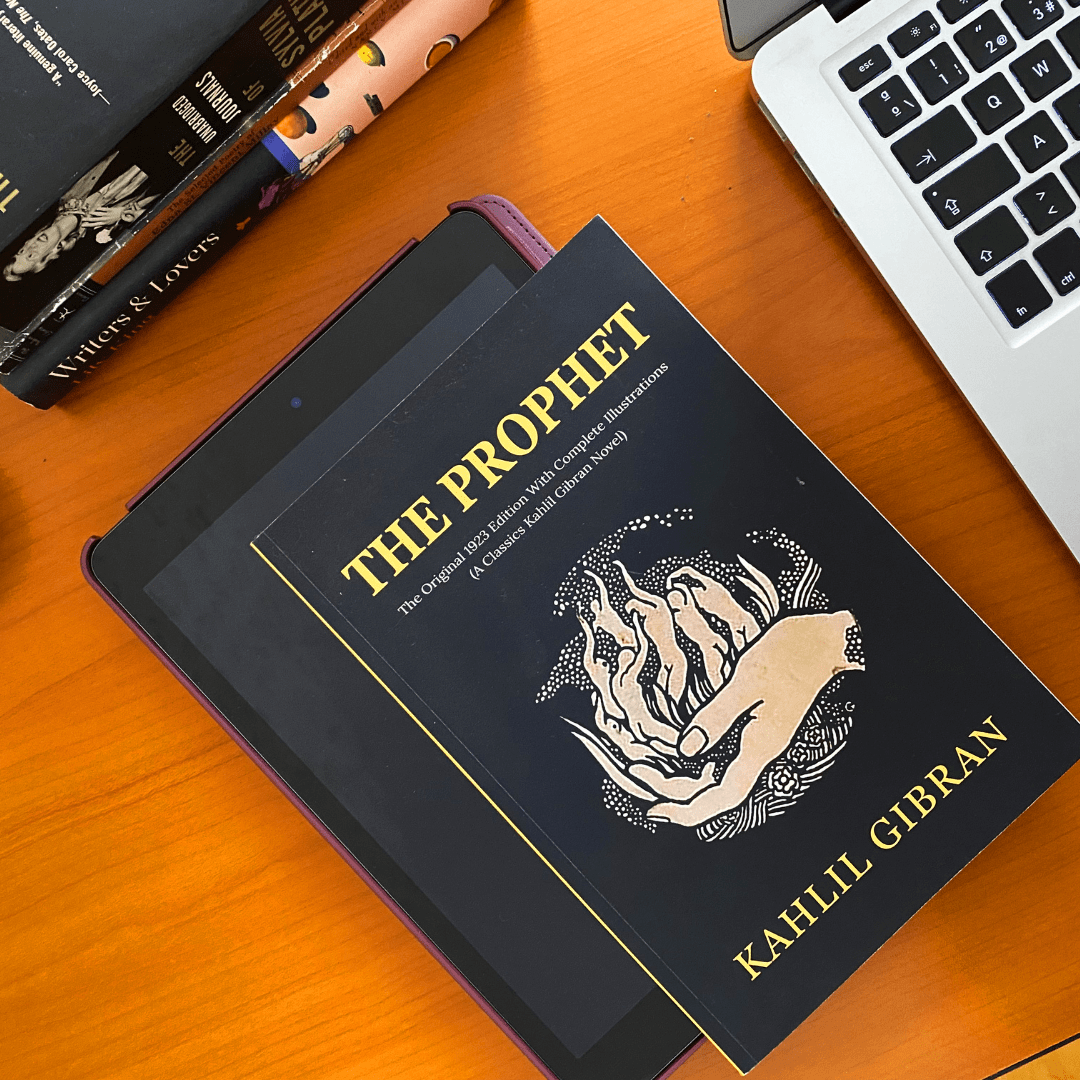
This book is a spiritual journey that explores conditions of the human soul and mind. It shares wisdom on topics such as purpose, joy, freedom, passion, sorrow and love. I have deep love and admiration for Kahlil Gibran’s writing and I would recommend this book to anyone and everyone. It is perfect if you are looking to nurture your mind and clear your spirit.
Here are some thought-provoking quotes and my personal take on them:
“The deeper that sorrow carves into your being, the more joy you can contain.”
Our capacity for experiencing joy and happiness is intricately linked to our encounters with sorrow and pain. Both sides of the scale are beneficial for personal growth, transformation and understanding. Navigating through moments of sadness, loss and hardship enhances our emotional depth and capacity to contain and appreciate moments of joy.
“It is well to give when asked, but it is better to give unasked, through understanding… for to withhold is to perish.”
Taking the initiative to help without waiting for a direct request means you have empathy towards the needs and feelings of others, means you don’t need an external force to convince you to be of service or offer help when you see someone else struggling. The act of giving when unasked is motivated by another person’s needs and the willingness to provide support and kindness. Also, the warning of “to withhold is to perish” suggests that refusing to give, especially when you have the means and understanding to do so, can lead to a sense of spiritual or moral deterioration, or a loss of the opportunity for personal growth and connection with others.
“And when one of you falls down he falls for those behind him, a caution against the stumbling stone.”
“And still more often the condemned is the burden bearer for the guiltless and unblamed.”
The falling on the stumbling stone symbolizes the mistakes that people can make, and warns us not to judge people for their actions for we are blessed not to be in their shoes. When the water isn’t clear we should refrain from pointing fingers since we are most likely ignorant to the truth or the experience.
“Verily all things move within your being in constant half embrace, the desired and the dreaded, the repugnant and the cherished, the pursued and that which you would escape. These things move within you as lights and shadows in pairs that cling.”
It will not always be sunny in your interior and it is not reasonable to expect that it is, the darkness in you does not discredit the light, nor should it be avoided, for in naming and recognizing the monster you take away its power. Light and dark need to coexist or else we would never know our own depth, we would never acknowledge our needs and we could never be grateful for the good we have inside.
“And could you keep your heart in wonder at the daily miracles of your life, your pain would not seem less wondrous than your joy; and you would accept the seasons of your heart, even as you have always accepted the seasons that pass over your fields. And you would watch with serenity through the winters of your grief.”
Reminds us to be kind with ourselves and to allow our mind, body and soul to feel deeply what we are going through, to not try to avoid the suffering and misfortune as we might only prolong it. We need to respect ourselves enough not to undermine our own experiences, and to be thankful we get to feel and understand such complex emotions, that we are capable and lucky to do so.
“For what is evil but good tortured by its own hunger and thirst.”
When you realize all the villain wanted was to be understood and to stop swallowing their pain and shame. Let yourself find a safe space where you can feel and work through the difficult emotions, so that they don’t become all that you are.
“You are good when you walk to your goal firmly and with bold steps. Yet you are not evil when you go thither limping. Even those who limp go not backward. You are good in countless ways, and you are not evil when you are not good.”
It conveys a message of acceptance and understanding regarding one’s actions and life’s journey. It suggests that being “good” is not solely determined by the outcome or the perfection of one’s actions, but rather by the intent, effort, and resilience put into them.
You are not inherently “evil” for experiencing obstacles or moments of weakness. Your worth is not defined solely by your successes or failures; it’s a holistic assessment of your efforts, intentions, and actions.
“Your daily life is your temple and your religion. Whenever you enter into it take with you your all.”
Reminds us to transform our everyday existence into a source of spiritual and personal growth and understanding. To think and act with intention and mindfulness. To live in the moment and experience each day like the blessing that it is. To hold everything as it is and to let it flow.
“You are also as strong as your strongest link. To measure you by your smallest deed is to reckon the power of the ocean by the frailty of its foam. To judge you by your failures is to cast blame upon the seasons for their inconstancy.”
It validates the idea that an individual’s strength and worth should not be solely determined by their smallest actions or their failures in life. It emphasizes the importance of considering the entirety of a person’s actions and qualities, recognizing that everyone has strengths and weaknesses, and acknowledging that failure and making mistakes is a natural part of the human existence.
Overall this book inspires a deeper appreciation for a more empathetic and holistic outlook on the human experience. It delves into the intricacies and enigmas of life, embracing both its highs and lows, shedding light on the revered and the concealed aspects of existence. It shares invaluable wisdom on embracing our own experience, seeking understanding, and cultivating gratitude in our journey.
 eclectic book talk